
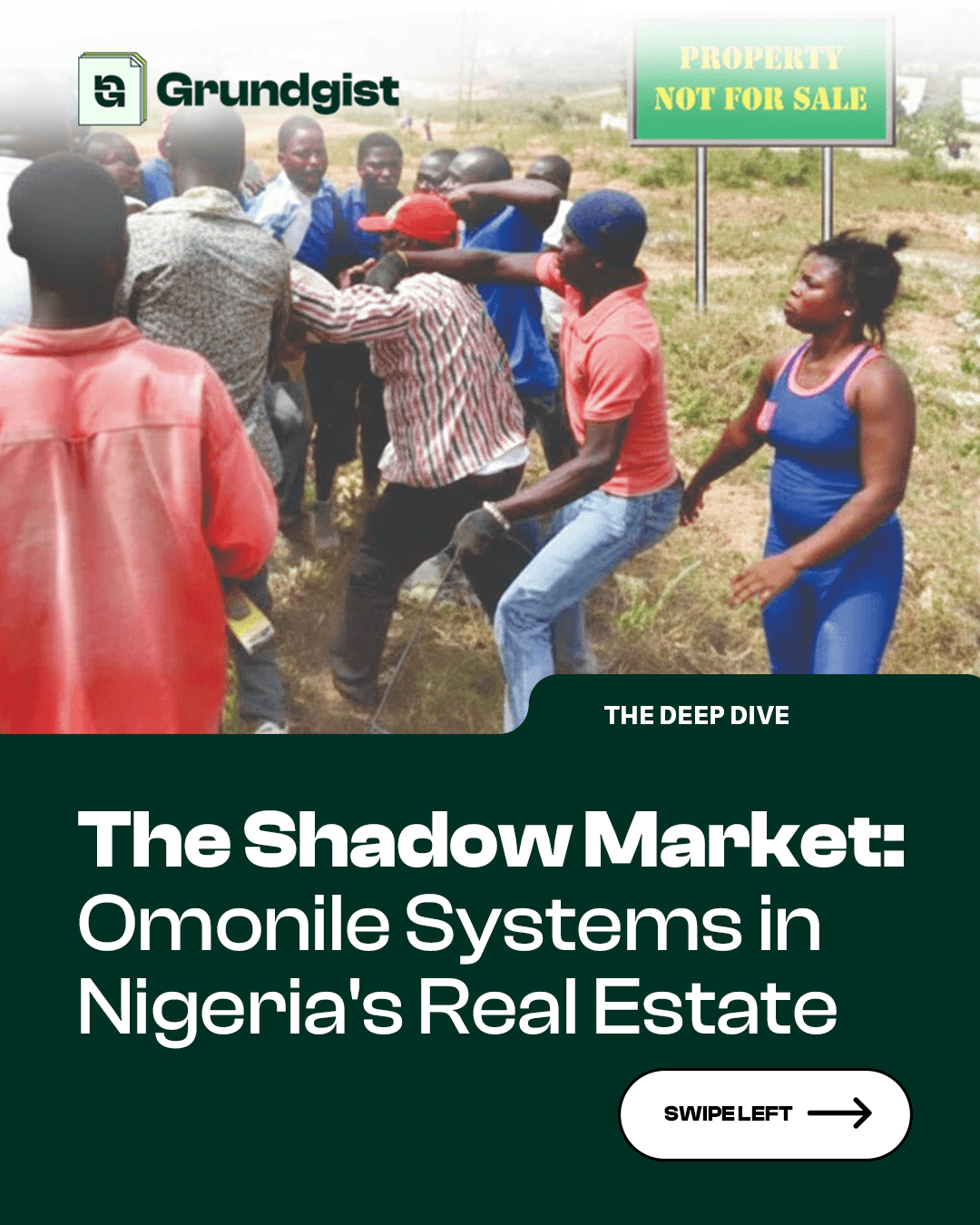
The stability of Nigerian real estate, especially in fancy parts of Lagos mainland and the quickly growing areas of Ibadan, is seriously messed up by a major headache: the Omonile issue.
Despite a decade of "Property Protection Laws" and the rise of digital land registries, the informal land-tenure system, colloquially known as the Omonile (Sons of the Soil), remains a multibillion-naira friction point. For the Nigerian investor, particularly those in the Diaspora, the Omonile is not just a cultural nuance; it is a systemic risk that can devalue an asset by up to 40% before the first brick is even laid.
Today, GrundGist interrogates why this "Shadow Market" persists in 2026 and how technology is finally moving the needle from "negotiation" to "verification."
The Economic Cost of Informal Tenure
Nigeria’s real estate market is estimated at over $900 billion (₦1.2 trillion), yet a significant portion of this value is "dead capital." Why? Because land without a clear, undisputed title cannot be leveraged for credit.
The Omonile system thrives in this lack of documentation. When a family sells a communal plot without a registered survey, they are essentially selling a "promise" of ownership. According to GrundGist’s internal data, 7 out of 10 land disputes in Lagos State originate from overlapping communal claims where a single family unit sells the same coordinate points to multiple buyers.
Why the "Property Protection Law" Isn't a Silver Bullet
In 2016, the Lagos State Government enacted the Property Protection Law to criminalize land-grabbing. While the law led to high-profile arrests, the "Shadow Market" evolved.
Instead of overt violence, the modern Omonile operates through "Administrative Friction." This includes:
The Foundation Fee Trap: Demanding "signing fees" that aren't in any legal contract but are required to avoid site disruptions.
Secondary Sales: Selling the same land to a second buyer who has "better connections," forcing the original buyer into years of litigation.
For the investor, the cost of litigation often exceeds the cost of the land itself. In Nigeria, the average land dispute in a High Court takes 5 to 12 years to resolve.
Moving from Paper to Code
If the problem is a lack of data, the solution is PropTech. We are seeing a shift where "Trust" is no longer a handshake; it’s a cryptographic proof.
1. Coordinate Charting: Traditional agents sell "plots." Modern investors buy "coordinates." By using satellite-verified mapping, platforms like Grundpay allow a buyer to see if a plot is "Committed" (owned by the government) or "Free" before a kobo is exchanged.
2. The Digital Ledger: The reason Omoniles sell land twice is that there is no public, real-time "Sold" sign on the land registry. Digital platforms are now building private ledgers that act as a "Clearance House" for land. If a plot is on the ledger, its transaction history is visible.
Distance as a Strategic Advantage
Historically, Nigerians abroad were the biggest victims of the Omonile system, often scammed by the very relatives sent to "watch the land."
However, in 2026, distance is becoming a strategic advantage. By removing the "family middleman" and using independent research platforms like GrundGist and GrundSafe, Diaspora investors are actually making safer bets than locals. They are relying on Data (Registry searches) rather than Sentiment (Family ties).
The GrundGist Verdict
The Omonile system survives because it fills a gap left by an inefficient government registry. To beat the "Shadow Market," we must stop treating land as a social favor and start treating it as a digital asset.
The Rule for 2026: If the land isn't charted, verified, and payment-tracked via a secure infrastructure, you aren't buying real estate—you’re buying a lawsuit.