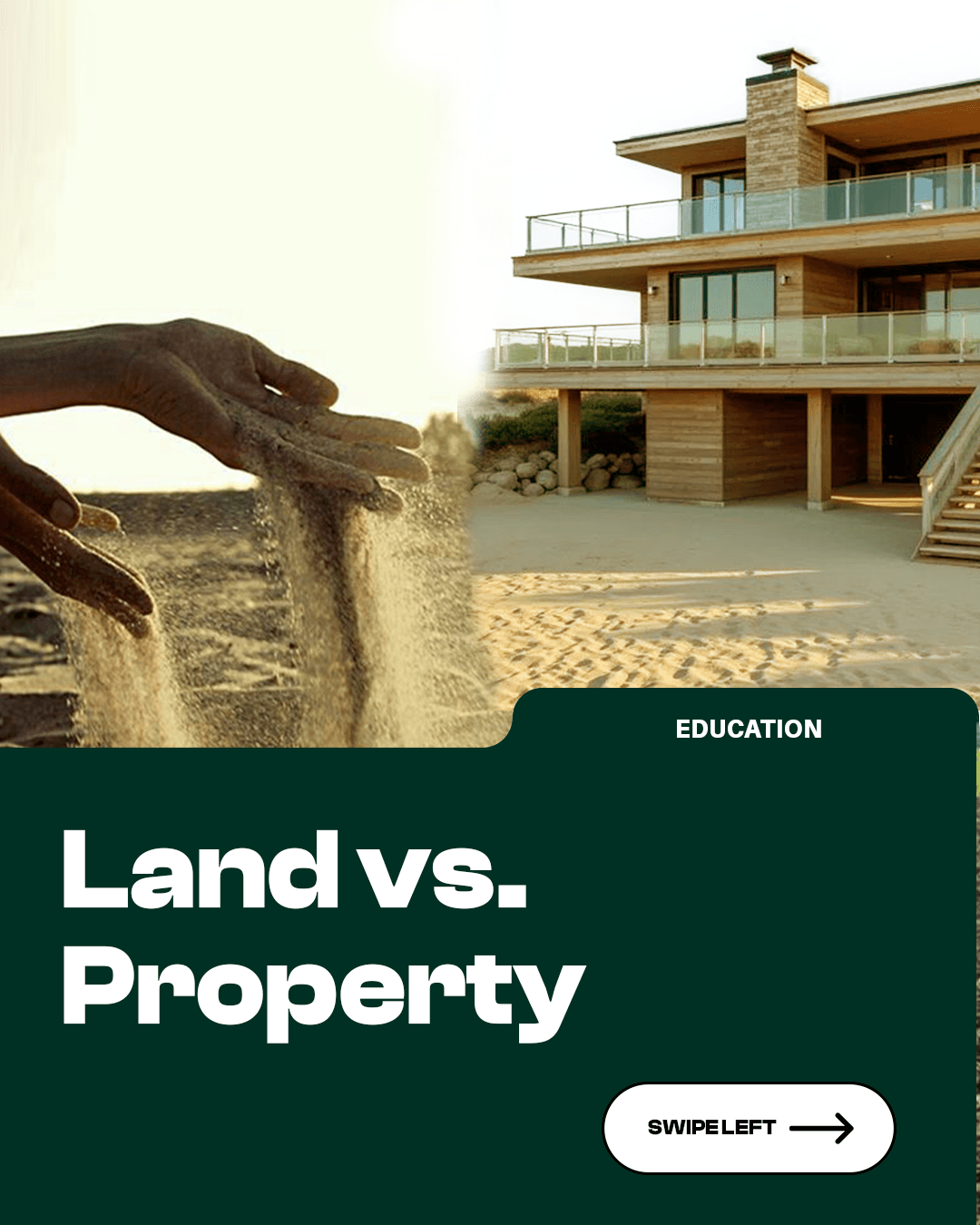
In the world of real estate, words carry weight. If you tell a lawyer you are buying "property" when you are actually buying "land," you might miss out on the specific legal protections required for each.
At GrundPay, we believe an informed investor is a protected investor. Here is the ultimate breakdown of the difference between the soil beneath your feet and the roof over your head.
1. The Core Definition: Raw vs. Refined
The simplest way to look at it is through the lens of manufacturing:
i. Land is the "Raw Material": It is the earth’s surface, extending down to the center of the earth and upward to the sky. It includes everything provided by nature—trees, water, and minerals.
ii. Property is the "Finished Product": In legal terms (specifically Real Property), this refers to the land plus any man-made improvements attached to it. This includes houses, fences, boreholes, and even paved driveways.
2. The Due Diligence Checklist
Because they are different "products," the way you verify them before paying must also differ.
Buying Land? Focus on the "Boundaries & Use"
When buying raw land in Nigeria, your biggest enemies are encroachment and wrong zoning.
i. The Survey Plan: You must verify that the coordinates on the paper match the physical ground.
ii. Zoning & Land Use: Is the land designated as Residential, Commercial, or Agricultural? If you build a house on industrial-zoned land, the government can demolish it.
iii. The Charting: You must "chart" the coordinates at the Surveyor General’s office to ensure it isn't under "Global Acquisition" (land reserved by the government).
Buying a House (Property)? Focus on "Structure & Title"
When there is a building on the land, the stakes get higher.
i. Structural Integrity: You aren't just buying dirt; you’re buying concrete. You need a structural engineer to check for cracks, dampness, and foundation strength.
ii. Approved Building Plan: Many Nigerians have a C of O for the land but never got a "Building Approval" for the house. Without this, the building is technically illegal.
iii. Service & Utility Liens: Are there outstanding electricity bills, security dues, or "Omonile" fees attached to the physical structure?
3. The "Bundle of Rights"
Whether you own land or a house, what you are actually buying in Nigeria is a Right of Occupancy. Under the Land Use Act of 1978, all land is vested in the State Governor. Your "ownership" is essentially a long-term lease (usually 99 years).
The difference is that with Property, your "bundle of rights" includes the right to exclude others from a physical structure, whereas with Land, your rights are focused on the potential of what can be built.
Think of it like this: Land is the canvas; Property is the painting. You cannot have a painting without a canvas, and the quality of your canvas determines how long your painting will last. If you are buying land to "bank" it for the future, focus on location and title. If you are buying a house to live in or rent out, focus on compliance and construction quality.